What holds a broken bone still
A fracture heals when the bone ends are held in the right position, without movement, for long enough. Everything in fracture surgery serves that one requirement.
Our fracture repair service uses several approaches, chosen for the fracture pattern rather than out of habit. For Talleyville dogs, the most common causes we see are slips on icy steps in winter, collisions during off-lead running, and road accidents.
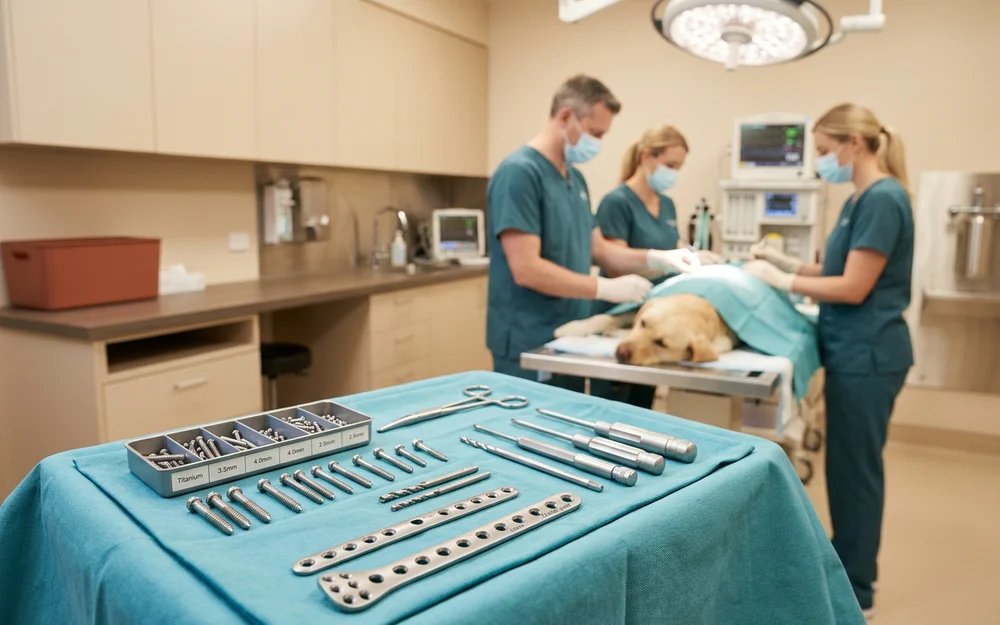
Dynamic compression plating (DCP and LC-DCP). A metal plate is shaped to the bone and fixed with stainless steel cortical screws. The plate design lets the screws press the fracture fragments together as they are tightened, which is exactly what bone needs to heal. Plates give rigid stability and suit long-bone fractures under load.
Intramedullary (IM) pinning. A pin is passed down the marrow cavity along the length of the bone. It resists bending very well and rotation hardly at all, which is why an IM pin is usually paired with K-wires or a cerclage wire to control twisting forces.
Kirschner wires (K-wires). Fine wires used in small bones, in young dogs, or alongside a pin to hold individual fragments in place.
External fixation. Pins pass through the skin into the bone and connect to a frame outside the leg. Because no hardware sits at the fracture site itself, this is the go-to choice for open or contaminated fractures where implant infection is a real risk.
How bone actually heals
Bone does not heal like a cut. It moves through set stages, and none of them can be rushed.
Inflammation (days 1 to 7). A blood clot forms at the fracture and inflammatory cells clear debris. The leg is at its most painful during this week, so pain relief on schedule matters most now.
Soft callus (weeks 1 to 3). A bridge of cartilage and fibrous tissue forms across the break. It holds the bone ends together but is not yet strong. Toilet breaks on a short lead only.
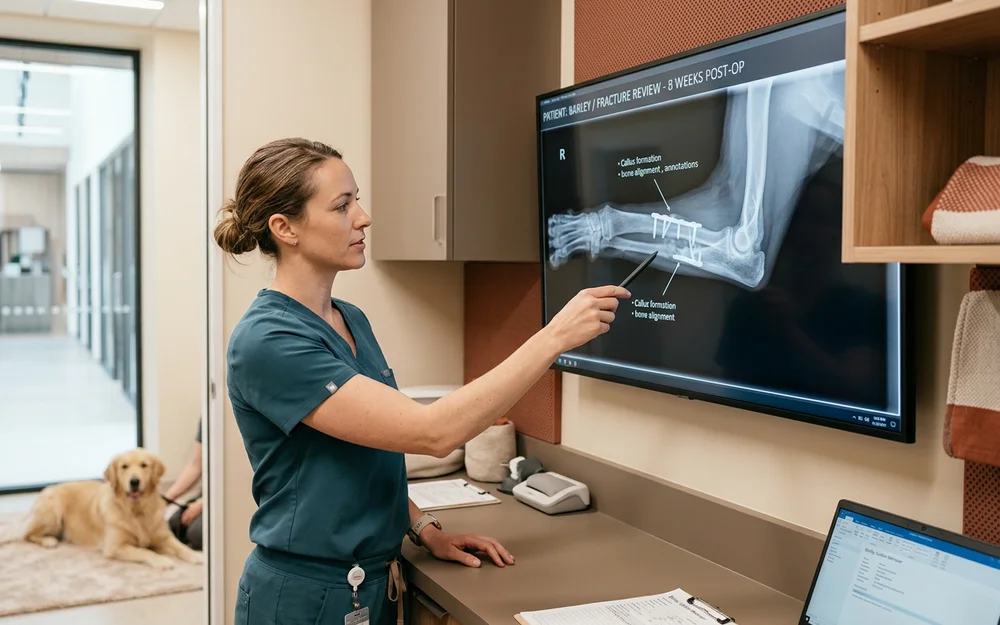
Hard callus (weeks 3 to 8). The soft callus mineralizes into woven bone. This is when callus formation becomes visible on radiographs, and it is the stage the surgeon looks for before easing any restrictions. The first recheck film is typically taken around week four to six.
Remodeling (months). The woven bone is gradually reshaped into normal bone along the lines of stress. This continues long after your dog is walking normally, which is why a gradual return to running and jumping is better than a sudden one.
Why recheck radiographs decide everything
How well your dog is walking tells you nothing useful about how well the bone is healing.
Dogs are keen weight-bearers. A dog three weeks into a twelve-week healing period will happily trot on a leg held together by hardware and soft callus, and will treat any loosening of the rules as permission.
Orthogonal recheck radiographs, two views at right angles, show the true state of the callus. Restrictions come off when the images say so, usually in stages: longer lead walks first, then controlled off-lead time in a fenced yard, then normal exercise.
The recovery nobody warns you about
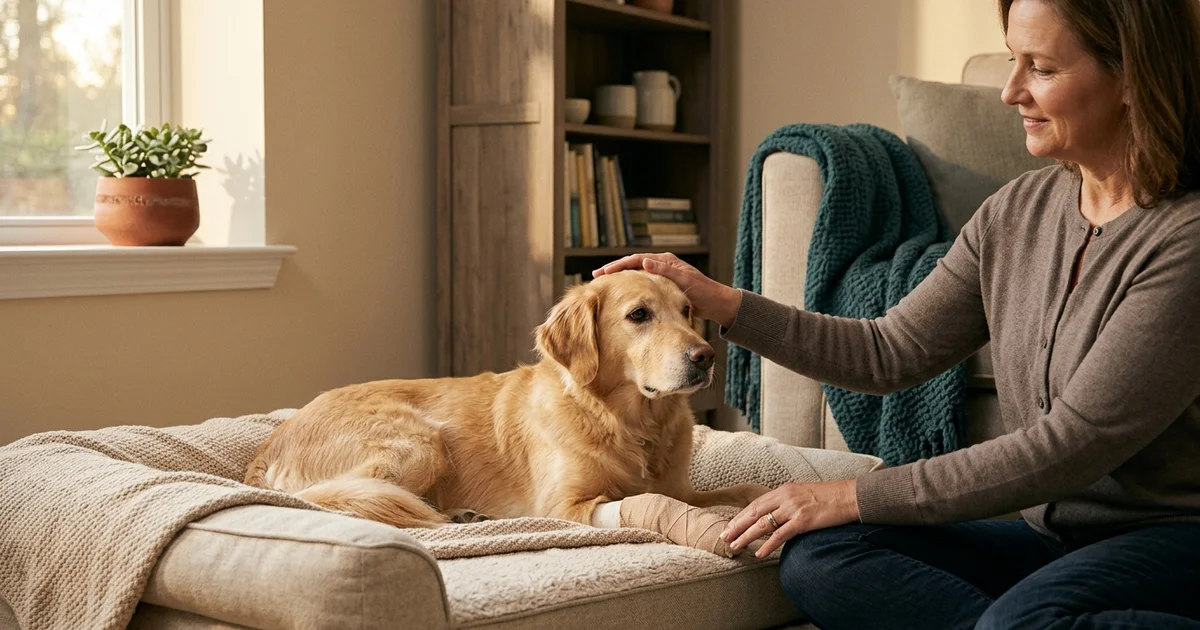
Strict confinement is genuinely hard, and it is the part of fracture repair owners underestimate every time.
- Crate or single-room rest, ideally on non-slip flooring
- Short, lead-only toilet breaks
- No stairs, no furniture, no jumping in or out of the car
- No off-lead running until cleared on radiographs
- No play with other dogs in the house
Non-union prevention depends almost entirely on this. A fracture that fails to heal is usually one that was not kept still enough, and the movement nearly always came from a dog who felt fine.
Six to twelve weeks of enforced rest is a long time. It is also the difference between a leg that works normally on the trails for the next decade and one that does not. Puzzle feeders, chew toys, and short training sessions help keep a confined dog’s mind busy.
Before any of it
If your dog has been hit by a car, go to the nearest emergency hospital first. Chest injury, abdominal bleeding, and shock are what kill in the first hours, not the leg. Once your dog is stable, Talleyville Dog Surgery can plan the repair, usually within days.