Common Questions
Dog surgery FAQs
Real questions from dog owners across the Brandywine Valley — about pricing, scheduling, safety protocols, and what to expect on the day of surgery and after.
General
General questions
About our network, pricing, scheduling, and how we work across the Brandywine Valley.
Common Questions
Frequently Asked Questions
01Why is dog surgery through you cheaper than the referral hospitals near Talleyville?
Your dog's surgery is performed by an experienced general practice veterinary surgeon in our network rather than inside a corporate-owned referral or emergency hospital. Those hospitals carry heavy facility and staffing overhead, and it shows up on the invoice. Our surgeons carry far less, so prices run 30-40% lower while the safety protocol (bloodwork, continuous monitoring, nerve blocks, follow-up evaluation) stays the same.
02How fast can a Talleyville dog get a surgical date?
Urgent cases such as a suspected obstruction, pyometra, or a bleeding spleen are booked same or next day. Planned procedures like mass removal or dental extractions are usually scheduled within two weeks. Because we coordinate several surgical calendars across northern New Castle County, we are not limited to one hospital's four-to-six week queue.
03My regular vet on Concord Pike referred me out. Can I come to you instead?
Yes. Many owners contact us after their general practice vet finds a problem but does not perform the surgery in-house. Send us whatever records, X-rays, or estimates you already have. We will review them, confirm whether surgery is the right step, and give you a price and a date. We are always happy to keep your regular vet informed.
04My dog is twelve. Is anesthesia safe?
A large share of the dogs we operate on from established Brandywine Hundred neighborhoods are seniors. Every one has comprehensive pre-anesthetic blood screening before a date is confirmed, so the anesthetic is built around real liver, kidney, and blood values. SpO2, ECG, blood pressure, and core temperature are then monitored continuously by a dedicated team member from induction to recovery.
05My dog tore a cruciate ligament on the trail. Do you do TPLO?
No. Cruciate tears are common in active dogs around Brandywine Creek State Park and Alapocas Run, but TPLO and other elective orthopedic procedures are outside our scope. We repair traumatic bone fractures with plating, pinning, and external fixation. If your dog needs a TPLO, we will say so honestly and help you find a surgeon who performs it routinely.
06My dog swallowed something. When is it an emergency?
Treat it as urgent if your dog is vomiting repeatedly, refusing food, straining, unusually quiet, or has a tender belly after swallowing an object. Corn cobs, socks, toys, string, and creek-bed stones are the most common culprits we see. Call us on (302) 599-0299. An obstruction caught early is usually a simpler, cheaper operation than one left for a few days.
07Which areas near Talleyville do you serve?
We serve Talleyville and the wider Brandywine Hundred, including Sharpley, Fairfax, Woodbrook, Edenridge, Chalfonte, and Weldin Ridge, plus Greenville, Centerville, Hockessin, Claymont, and North Wilmington. Owners from Chadds Ford and Glen Mills in Pennsylvania also book with us via US-202.
08What support do I get once my dog is home?
Every surgery includes home-recovery medications, a written discharge checklist, access to a 24/7 post-op text line, and a complimentary healing evaluation at 10 to 14 days. If something looks wrong at 2am, you text the line rather than guessing.
09Can I spread the cost of my dog's surgery?
Yes. We accept cash, credit card, and CareCredit, which lets you pay over monthly installments. If cost is a concern, mention it when you request a booking and we will walk through the options before you commit.
10Do you offer spay and neuter surgery for Talleyville dogs?
Yes. Our Premium Spay & Neuter packages include pre-anesthetic blood panels, continuous vital monitoring, multi-modal pain control, and cosmetic subcuticular closures with no external staples. Neuters start at $185 and spays at $245. Spaying also removes the risk of pyometra later in life.
Still have questions about your dog?
Send us the details and we will come back with a straight answer, an honest price, and the soonest surgical date we can offer.
Request Surgery BookingBladder Stone Surgery (Cystotomy) in Talleyville
Bladder Stone Surgery questions
Specific questions about bladder stone surgery — pricing, recovery, and when it's urgent.
Common Questions
Frequently Asked Questions
01How much does dog bladder stone surgery cost in Talleyville?
Our urolith extraction package starts at $950 (2026 pricing). It includes pre-anesthetic blood screening, urinalysis, anesthesia with continuous monitoring, the cystotomy, retrograde urethral hydropropulsion, medications, and the follow-up healing evaluation. Referral hospitals in the area commonly quote $3,000 or more. Stone analysis and any prescription diet are quoted separately because they depend on what is found.
02My dog is straining but nothing is coming out. What do I do?
Go to the nearest emergency hospital now. A dog that strains and produces no urine may have a complete urethral obstruction, which backs pressure into the kidneys and can become life-threatening within about a day. Once your dog is decompressed and stable, contact us about the surgery itself. If urine is still coming out, call us the same day.
03Can my dog's stones be dissolved with diet instead?
Some can. Struvite stones often dissolve over several weeks with a therapeutic diet and treatment of any urinary infection. Calcium oxalate stones do not dissolve and must be removed surgically. That is why identifying the stone type matters so much.
04Is blood in the urine normal after surgery?
Yes, for the first three to five days. It should get lighter each day. Heavy fresh bleeding, clots, or straining with nothing produced needs an immediate call or text to the recovery line.
05How do I stop the stones coming back?
Three things make the biggest difference: removing every fragment including any in the urethra, feeding the diet matched to the stone analysis, and keeping your dog drinking plenty of water. Periodic urinalysis catches a returning infection before it seeds new stones.
06How soon can surgery be scheduled?
Within days. Bladder stones are painful and can progress to complete obstruction, so they are not treated as routine elective surgery. Partially obstructed dogs are booked same or next day.
Still have questions about your dog?
Send us the details and we will come back with a straight answer, an honest price, and the soonest surgical date we can offer.
Request Surgery BookingCanine Dental & Oral Surgery in Talleyville
Dental & Oral Surgery questions
Specific questions about dental & oral surgery — pricing, recovery, and when it's urgent.
Common Questions
Frequently Asked Questions
01How much does dog dental surgery cost in Talleyville, DE?
Between $150 and $950 per procedure (2026 pricing), depending on how many teeth are involved and how difficult they are. That range includes pre-anesthetic bloodwork, anesthesia with continuous monitoring, infraorbital or mandibular nerve blocks, and digital dental X-rays. Complete cleanings start at $295. You get a realistic range before anesthesia, confirmed once the radiographs show what is happening below the gumline.
02Why can't the vet just pull the tooth?
Single-rooted front teeth can often be lifted out whole. Multi-rooted premolars and carnassials have two or three diverging roots, so the tooth must be sectioned, each root lifted separately under a gum flap, and the site closed. That is surgery, and it is priced as surgery.
03How do I know if my dog has tooth pain?
Dogs rarely stop eating because of dental pain. They adapt. Watch for chewing on one side, dropping kibble or toys, worsening breath, pawing at the face, flinching when the head is touched, or a sudden preference for soft food.
04Is anesthesia safe for my 13-year-old dog's dental work?
Pre-anesthetic bloodwork checks liver and kidney function first, nerve blocks keep the anesthetic light, and SpO2, ECG, blood pressure, and temperature are monitored throughout on a warmed table. Leaving infected, painful teeth in place has its own risks, and that is the comparison that matters.
05What is recovery like after extractions?
Most dogs eat softened food within a day or two and are back to normal within a week. Sutures dissolve on their own. Avoid hard chews and tug toys for about a week, and finish the pain relief even if your dog seems fine.
06Do you treat oral tumors and jaw fractures?
Yes. We remove benign oral tumors, repair jaw fractures, and close oroantral fistulas. If a mass looks malignant and needs staging first, we will tell you directly rather than proceeding.
Still have questions about your dog?
Send us the details and we will come back with a straight answer, an honest price, and the soonest surgical date we can offer.
Request Surgery BookingEmergency Foreign Body Removal in Talleyville
Foreign Body Removal questions
Specific questions about foreign body removal — pricing, recovery, and when it's urgent.
Common Questions
Frequently Asked Questions
01How much does dog foreign body surgery cost in Talleyville, DE?
From around $1,200 (2026 pricing). That already includes pre-op abdominal radiographs, pre-anesthetic blood screening, IV fluid support, anesthesia with continuous monitoring, the surgery, and post-operative medications. Emergency and referral hospitals commonly quote $3,000 to $5,000 for the same operation. Our price rises when a case is more complex, for example when damaged bowel needs resection and anastomosis or when a dog arrives septic.
02My dog just swallowed something. What should I do right now?
Call us before you do anything else. Act fast if you see repeated vomiting, refusal of food or water, lethargy, straining with no stool, a hunched posture, or a sore belly. Some small smooth objects pass, but there is no way to tell from the outside, and an obstruction left for two days is a far riskier operation than one dealt with today.
03Should I make my dog vomit at home?
No. Inducing vomiting can make some cases much worse. A corn cob or sharp bone coming back up can tear the esophagus, and a linear foreign body should never be moved. Sometimes induced vomiting is the right call, but a vet who knows what was swallowed and when needs to make that decision.
04Will the object show up on an X-ray?
Rocks and most bones show clearly. Fabric, rubber, and plastic often do not, so we read the pattern around them: gas build-up, bunched bowel loops, or free fluid. If radiographs are not conclusive, abdominal ultrasound usually settles it.
05Can the object be removed without surgery?
Sometimes. Endoscopy can retrieve some objects still in the stomach, but it cannot reach the small intestine, where most obstructions cause harm, and it still requires general anesthesia. We review the X-rays first and will tell you if a non-surgical option is realistic.
06What is recovery like after foreign body surgery?
About two weeks. Small, frequent, bland meals for the first several days, then a gradual return to normal food. Activity is restricted for the full fortnight. Call or text straight away if vomiting returns, your dog stops eating, or the incision swells or leaks.
Still have questions about your dog?
Send us the details and we will come back with a straight answer, an honest price, and the soonest surgical date we can offer.
Request Surgery BookingTraumatic Fracture Repair in Talleyville
Fracture Repair questions
Specific questions about fracture repair — pricing, recovery, and when it's urgent.
Common Questions
Frequently Asked Questions
01How much does dog fracture surgery cost in Talleyville, DE?
From around $1,800 (2026 pricing). That includes pre-anesthetic blood screening, anesthesia with continuous monitoring, reduction and fixation, the implants, immediate post-operative X-rays, and medications. Complexity pushes it higher: fractures in multiple fragments, fractures into a joint, open fractures needing an external fixator, and longer healing periods with more recheck X-rays.
02Does every broken bone need surgery?
No. Stable, non-displaced fractures, especially in young dogs, can heal in a Robert Jones bandage or cast with strict rest. Surgery is needed when the fracture is displaced, in several fragments, involves a joint, or will not stay aligned. The X-rays decide.
03My dog tore a cruciate ligament. Can you help?
Not surgically. Cruciate tears are common in active dogs on local trails, but TPLO and other elective orthopedic procedures are outside our scope. We will tell you plainly and point you toward a surgeon who performs them routinely.
04How long will the bone take to heal?
Usually six to twelve weeks, quicker in young dogs and slower in older ones. Recheck X-rays confirm progress, because dogs will happily walk on a bone that is nowhere near healed.
05What does crate rest really involve?
More than most owners expect. A crate or small room, lead-only toilet trips, no stairs, no jumping on furniture, and no off-lead running until the X-rays clear it. Movement at the fracture site is the main cause of a bone that fails to heal.
06My dog was hit by a car. What do I do first?
Go straight to the nearest emergency hospital. Chest injury, internal bleeding, and shock are the dangers in the first hours, not the leg. Once your dog is stable, contact us about the fracture repair.
Still have questions about your dog?
Send us the details and we will come back with a straight answer, an honest price, and the soonest surgical date we can offer.
Request Surgery BookingCanine Mass & Tumor Removal in Talleyville
Mass & Tumor Removal questions
Specific questions about mass & tumor removal — pricing, recovery, and when it's urgent.
Common Questions
Frequently Asked Questions
01How much does dog mass removal cost in Talleyville, DE?
Mass removal starts at $450 (2026 pricing). That covers pre-anesthetic blood screening, anesthesia, continuous vital-sign monitoring, the excision, a cosmetic subcuticular closure, home medications, and the complimentary 10-to-14 day healing evaluation. Size, depth, and number of masses move the price: one small superficial lump sits at the bottom of the range, while a large deep mass or several masses in one session cost more. Histopathology is quoted separately.
02Can you tell whether my dog's lump is cancer just by feeling it?
No, and nobody honestly can. A soft lipoma and a mast cell tumor can feel almost identical. A fine-needle aspirate in the consult room gives a strong indication within minutes, and histopathology after removal confirms the diagnosis. Rapid growth, firmness, ulceration, bleeding, or a mass fixed to the tissue underneath are the features that raise concern.
03My senior dog has several lumps. Should they all come off?
Not necessarily. Older dogs often collect several benign lumps, and a small, stable, confirmed-benign mass can be monitored. We recommend removal when a lump is growing, changing, interfering with movement, ulcerating, or when we cannot be confident it is benign. If several do need removing, doing them under one anesthetic is usually cheaper and safer.
04How long will my dog be away from home on surgery day?
Most of the day. Surgical time for a single skin mass is usually under an hour, but admission, pre-anesthetic checks, and supervised recovery fill the rest. Most Talleyville dogs are home by the evening.
05Does my dog really need a cone?
Usually yes, for about two weeks. Subcuticular closures give dogs much less to chew at than staples, but a persistent licker can still open an incision. Two weeks of cone is far easier than treating an infection or a reopened wound.
06When can my dog go back on the trails?
Once the incision is checked and cleared at the 10-to-14 day evaluation. Until then it is lead walks only, with no off-lead running, jumping, or swimming in the creek.
Still have questions about your dog?
Send us the details and we will come back with a straight answer, an honest price, and the soonest surgical date we can offer.
Request Surgery BookingEmergency Pyometra Surgery in Talleyville
Pyometra Surgery questions
Specific questions about pyometra surgery — pricing, recovery, and when it's urgent.
Common Questions
Frequently Asked Questions
01How much does pyometra surgery cost in Talleyville?
From around $1,100 (2026 pricing). That includes pre-anesthetic blood screening, IV fluids, broad-spectrum antibiotics, the ovariohysterectomy, continuous monitoring, and post-operative medications. Corporate emergency hospitals typically quote $2,500 to $4,000 or more. Dogs who arrive severely septic need more support and cost more, and we tell you that before surgery. CareCredit is accepted.
02My female dog finished her season a month ago and now seems off. Should I worry?
Yes, call today. Lethargy, a poor appetite, drinking and urinating more than usual, or vomiting in an unspayed female in the two months after a heat cycle is the classic picture of pyometra. A discharge may or may not be present. No discharge does not rule it out, and can mean the more dangerous closed form.
03Can pyometra be treated with medication instead?
Medical treatment with prostaglandins exists, but it is slow, unreliable, suitable only for some stable open cases, and the problem often returns at the next season. Surgery is the standard of care because it removes the infection permanently.
04Is my dog too sick to have surgery?
Being sick is the reason surgery is needed, because the infection will not clear while the uterus remains. What changes is the preparation: IV fluids and antibiotics before induction, continuous monitoring throughout, and an anesthetic adjusted to her measured blood and kidney values.
05How quickly will she recover?
Most dogs look dramatically brighter within 24 hours. Full recovery takes about two weeks of restricted activity plus a complete antibiotic course. The complimentary healing evaluation at 10 to 14 days confirms she is back to normal.
06Can pyometra happen again?
No. The ovaries and uterus are removed, so it cannot recur. Spaying a female you do not plan to breed is the most effective prevention there is.
Still have questions about your dog?
Send us the details and we will come back with a straight answer, an honest price, and the soonest surgical date we can offer.
Request Surgery BookingCanine Splenectomy in Talleyville
Splenectomy questions
Specific questions about splenectomy — pricing, recovery, and when it's urgent.
Common Questions
Frequently Asked Questions
01How much does dog spleen removal cost in Talleyville?
From around $1,500 (2026 pricing). That covers pre-anesthetic blood screening, anesthesia with continuous Lead II ECG monitoring, the splenectomy, post-operative PCV and lactate monitoring, and medications. Imaging and histopathology are quoted separately. Referral hospitals commonly quote $3,000 to $5,000 for the same surgery.
02Is a splenic mass always cancer?
No. Roughly half of canine splenic masses are benign, typically hematomas or nodular hyperplasia. The other half are malignant, most often hemangiosarcoma. No scan can reliably tell them apart, so histopathology of the removed spleen is the only definitive answer.
03Can my dog live normally without a spleen?
Yes. The liver and bone marrow take over the spleen's blood-filtering and storage roles. Dogs live normal, energetic lives after a splenectomy with no special diet or lifelong medication needed for the missing spleen.
04Why is ECG monitoring so important for this surgery?
Splenic disease is closely linked to ventricular premature contractions, abnormal beats that can appear during surgery or in the 24 to 48 hours afterwards. Most settle on their own, but some need treatment, and you can only treat what you are watching for.
05My dog is 11. Is he too old for a splenectomy?
Splenic disease mostly affects older dogs, so age alone cannot decide it. Organ function and heart status matter, and both are assessed before surgery. A bleeding spleen left in place is not the safer choice.
06What should I watch for at home afterwards?
Pale gums, weakness, collapse, a swelling belly, or refusing food all need an immediate call. Otherwise expect two weeks of restricted activity, with histopathology results usually back within about a week.
Still have questions about your dog?
Send us the details and we will come back with a straight answer, an honest price, and the soonest surgical date we can offer.
Request Surgery Booking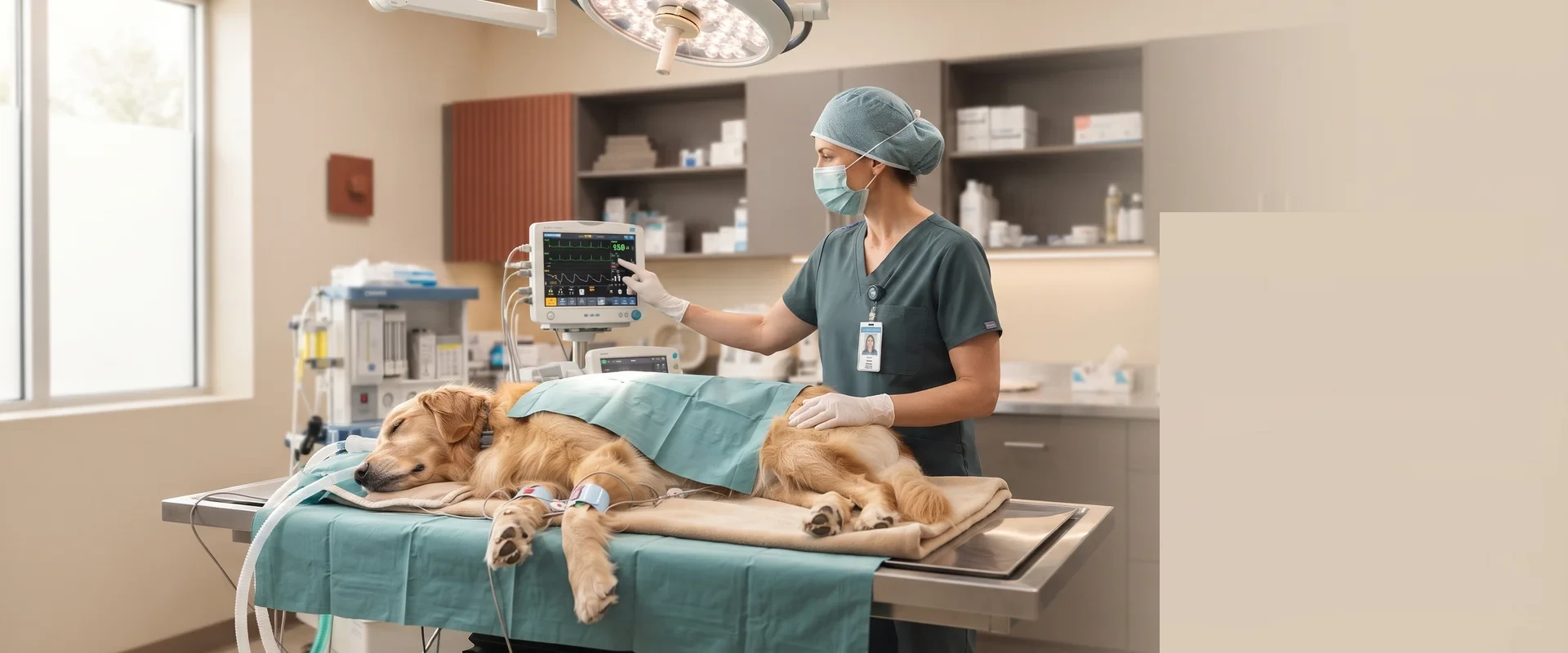
Urgent surgeries scheduled within days
Still have a question we have not answered?
Send us the details and we will come back with a straight answer, an honest price range, and the soonest safe date we can offer.
- 30-40% below referral hospitals
- Scheduled in days, not weeks
- Full monitoring on every case