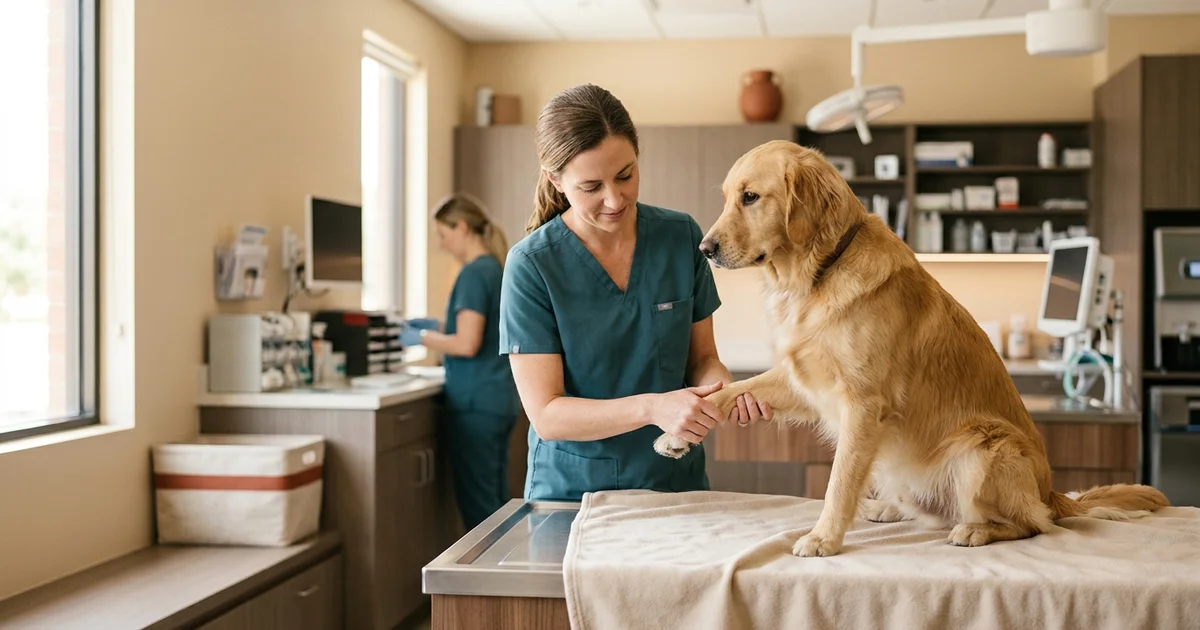
First: is it definitely a fracture?
Dogs are very good at hiding how badly they are hurt, and this is one of the questions Talleyville owners ask us most often. After a fall on icy steps or a bad landing on a muddy trail, a dog may simply refuse to put weight on a leg, and from across the room a fracture and a severe sprain look identical. That is why every case at our fracture repair service starts with radiographs. Images confirm exactly what you are dealing with.
This first step is what separates a guess from a plan.
Below are the factors that decide whether a fracture qualifies for surgery, when a splint is genuinely reasonable, and what to do today.
If your dog was hit by a car, go to an emergency hospital first.
Chest injury, abdominal bleeding, and shock are what kill in the first hours. The leg is visible and alarming, but it is rarely the priority. Get your dog stabilised, then we can plan the repair.
The four factors that decide it
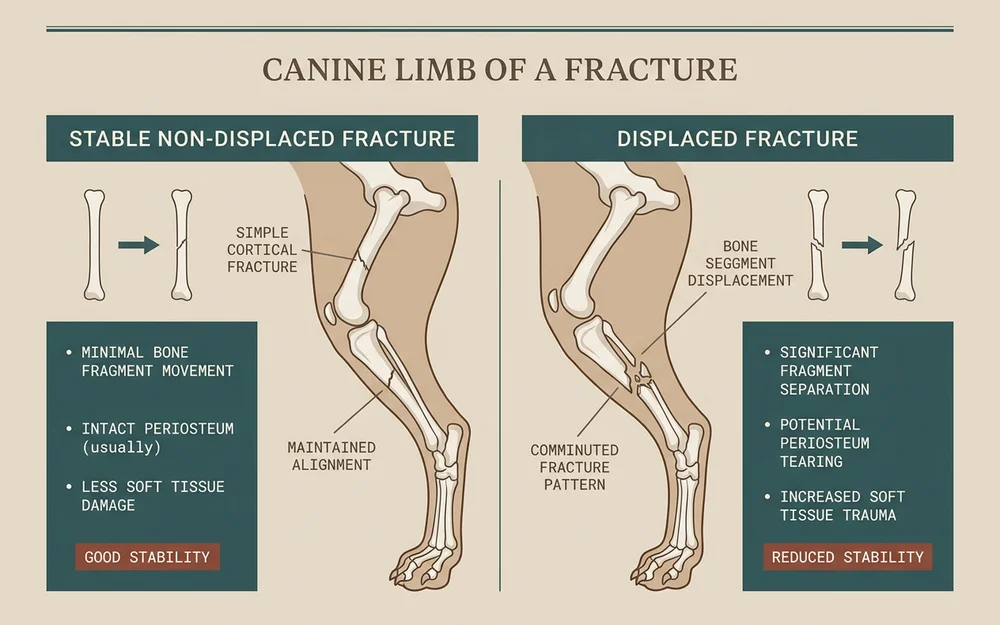
Whether a dog’s fracture needs surgery comes down to four things: displacement, the number of fragments, joint involvement, and whether the skin is broken. Each is judged from the radiographs, and together they point clearly toward either fixation or external support.
1. Displaced or non-displaced fractures
A non-displaced fracture means the bone ends are still in the right position. The bone is cracked but has not shifted. A displaced fracture means the ends have moved apart or overlapped, and that almost always means surgery. A bone left to heal out of line stays out of line, which leads to lifelong lameness. Plates and screws hold displaced bones in their correct position while they heal.
2. Simple or comminuted breaks
A simple fracture has two fragments. A comminuted fracture has three or more. Reassembling several pieces needs internal hardware such as a locking or compression plate rather than a cast, because only rigid fixation holds that many fragments still enough to knit.
3. Does it involve a joint?
A fracture that runs into a joint surface must be rebuilt very precisely. Even a small step in a joint surface leads to arthritis later in life. Joint-involving fractures are surgical cases, and the goal is to restore the joint to its exact original shape.
4. Open or closed injuries
An open fracture has broken through the skin, exposing bone to bacteria. These are emergencies that need thorough cleaning within the first few hours to prevent bone infection. They are often managed with external fixation, so no hardware is implanted directly into a contaminated site. A closed fracture keeps the skin intact and carries a much lower infection risk.
When a splint is genuinely reasonable
When weighing a splint against surgery, location matters enormously. A splint or cast only works for stable, non-displaced fractures below the elbow or the stifle (knee). Anything above those joints cannot be held still properly and needs surgery. External coaptation is only recommended when all of these apply:
- The fracture is stable and non-displaced: the bone must already be well aligned.
- Location: it must be below the elbow or stifle, so the cast can immobilize the joints above and below the break.
- The dog is young: puppies heal quickly, often in four to eight weeks compared with eight to twelve for adults.
- Genuine confinement: the household can deliver strict crate rest for the whole healing period.
- Regular bandage checks: the dressing is checked weekly for rubbing, sores, and slipping.
That last point needs real commitment. A badly managed bandage can cause pressure sores worse than the original fracture, and a cast that slips is holding nothing.
Breed and the specific bone also matter. Small and toy breeds have a poor blood supply to the lower front leg, and splinting a distal radius fracture in a toy breed fails often enough that plating is usually the better recommendation. A typical example is a young Yorkie who jumps from a sofa and breaks both bones just above the wrist. On paper it looks like a splint case. In practice, plating gives that dog a far better chance of healing straight.
Open versus closed reduction
Closed reduction realigns the bone ends without opening the fracture site, working from the outside under imaging guidance. Open reduction exposes the site through an incision so the surgeon can rebuild complex fractures directly. The method chosen is the one with the best chance of full function afterwards.
| Feature | Closed Reduction | Open Reduction |
|---|---|---|
| Technique | External manipulation using x-ray guidance | Direct surgical incision to access the bone |
| Blood Supply | Preserves the natural blood vessels around the break | Disrupts local tissue but allows for exact reconstruction |
| Best For | Simple, lower limb fractures in young dogs | Comminuted fractures, joint injuries, and trapped tissues |
| Hardware Used | Casts, splints, or external fixators | Internal locking plates, intramedullary pins, or K-wires |
Closed reduction protects the blood supply around the fracture, which helps healing considerably, but it takes skill to align the bone well from the outside.
Open reduction becomes necessary when fragments must be positioned one by one, when a joint surface needs rebuilding, or when soft tissue is trapped between the bone ends. It allows internal plates to hold complex fractures completely still through the eight to twelve weeks of healing.
What we do and do not treat
Our network repairs traumatic bone fractures using:
- Plating and bone screws
- Intramedullary pinning
- K-wire placement
- External skeletal fixation
Elective orthopedic surgery such as TPLO or patellar luxation correction is outside our scope. That is a deliberate boundary, not a gap we try to paper over. A TPLO treats a torn cranial cruciate ligament, a common injury in active dogs on local trails, and it deserves a surgeon who performs it every week. We will point you to one.
Traumatic fracture repair through Talleyville Dog Surgery starts at $1,800. Fracture surgery elsewhere commonly runs from $2,000 to $5,000 or more depending on the complexity of the break and the hardware needed. You get a written estimate based on your dog’s own radiographs before anything is booked.
What to do now
Get radiographs the same day to understand the real extent of the injury. Keep your dog strictly confined, do not try to splint the leg yourself, and never give human pain relief.
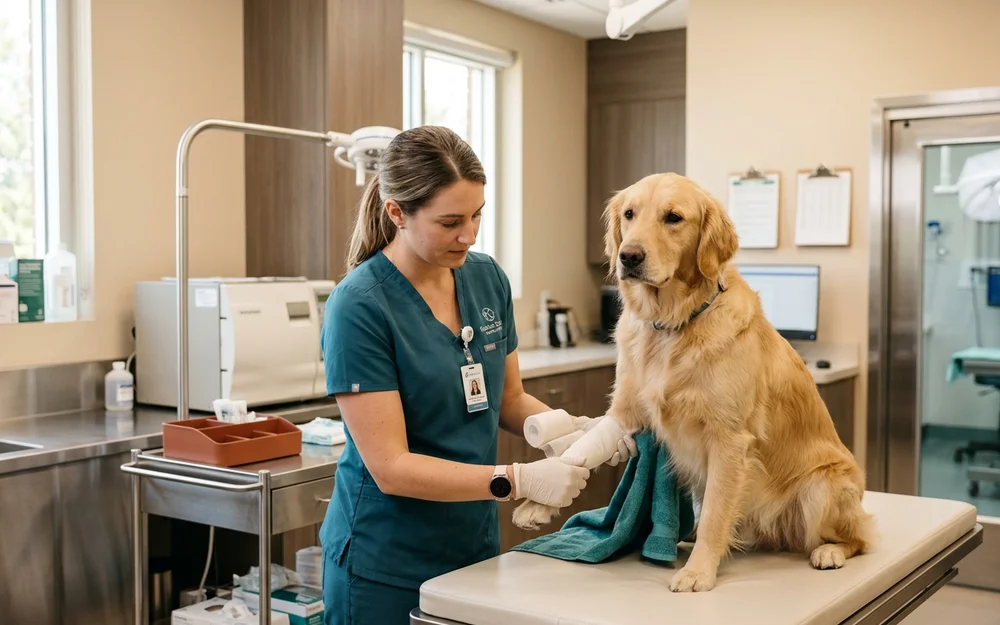
Common human painkillers such as ibuprofen and naproxen are toxic to dogs and can cause stomach ulcers and kidney damage even at a single dose. Use only pain relief prescribed by a veterinarian.
Once you have radiographs, call (302) 599-0299 or send them through. We will tell you whether this is a surgical fracture, explain the repair, and give you a clear cost and date.