
Toys are the year-round version of this problem
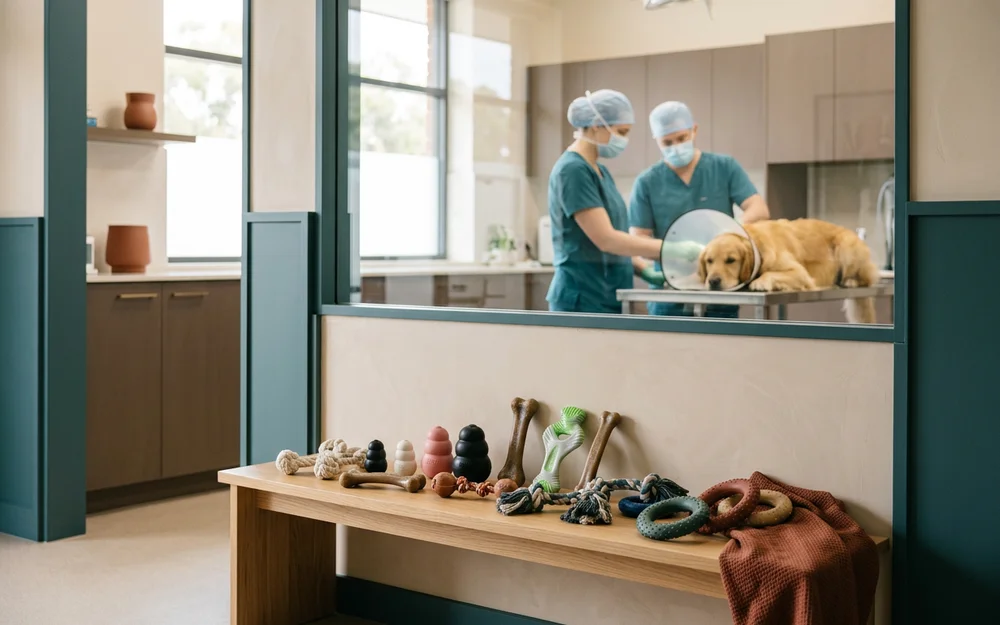
Corn cobs are seasonal. Toys are not. Balls, squeakers, chunks of rope, plastic limbs from plush toys, and pieces of chewed rubber turn up in our abdominal surgeries every month of the year, and our foreign body removal surgery team sees them constantly.
The irony is not lost on owners. The object was bought for the dog, and it was usually being used exactly as intended right up until it went down.
Which toys cause the most trouble
Balls are the most dangerous group, especially balls close to the width of the dog’s throat or intestine. A ball genuinely too big to swallow is safe. One that is only just swallowable is not. Solid rubber balls are worse than hollow ones because they will not squash. Owners with big retrievers who play fetch for hours in the yard often step down to a ball that is too small without realizing it.
Squeakers are their own hazard. Dogs dismantle the toy to get at the noise, then swallow the plastic insert. Squeakers are small, hard, and awkwardly shaped.
Rope toys shed strands, and a swallowed strand behaves as a linear foreign body, the most dangerous category of all. If your dog eats rope fibers, treat it with the same urgency as swallowed string.
Plush stuffing and limbs are usually less dangerous on their own but can collect into a wad that blocks the gut.
Why “he seems fine” is not reassuring

An object sitting in the stomach often causes no symptoms at all. There is room around it, food still passes, and the dog carries on as normal.
Trouble starts when the object moves into the small intestine and wedges, which can be six hours later or the next morning. That is why a bright dog straight afterwards tells you very little, and why we would rather hear from you when the toy disappears than when the vomiting starts.
A typical example: on a Tuesday evening, a two-year-old golden in Talleyville chews the end off a rubber bone and swallows a piece about the size of a walnut. She eats breakfast normally the next morning. By early afternoon she has vomited three times and is lying in her crate refusing a treat. X-rays show a dense shape in the upper small intestine with gas building up behind it. Because she was seen within 24 hours of swallowing, the surgeon removes it through a single enterotomy and the bowel wall is healthy.
Do not induce vomiting without calling first.
A hard toy coming back up can lodge in the esophagus. Some cases genuinely warrant it, but that decision needs a vet who knows what was swallowed and when.
Will it show on an X-ray?
That depends on the material. Metal and dense plastic show clearly. Rubber, fabric, and most soft plastics do not.
When the object itself is invisible, the surgeon reads the pattern it creates: gas building up behind the blockage, swollen loops of bowel, and a sudden change in diameter. If the films are unclear, abdominal ultrasound answers the question.
The signs
- Repeated vomiting, especially bringing water back up
- Refusing food, or eating and bringing it straight back
- Lethargy, hiding, or a hunched stance
- Straining to pass stool with nothing produced
- A tense, painful belly
- Drooling or repeated swallowing
Cost and scheduling
Foreign body removal starts at $1,200, including pre-op abdominal radiographs, pre-anesthetic blood screening, IV fluids, anesthesia with continuous multi-parameter monitoring, the procedure, and post-operative medications.
Objects still in the stomach come out through a gastrotomy, the simpler version. Objects in the intestine need an enterotomy, and where the bowel has been damaged by prolonged pressure, a resection. That last outcome is what seeing your dog early is meant to avoid. Urgent cases are booked within days, and the same day when the picture is time-critical.
What to do now
If your dog is collapsing, cannot keep water down, or has a rigid, painful belly, go to the nearest emergency hospital first.
Otherwise, call us now on (302) 599-0299. Tell Talleyville Dog Surgery your dog’s breed and weight, what the toy was made of, roughly how big the missing piece was, and when it disappeared. If you have an identical toy, keep it. Knowing the exact dimensions genuinely helps when reading the radiographs.